Clean Energy
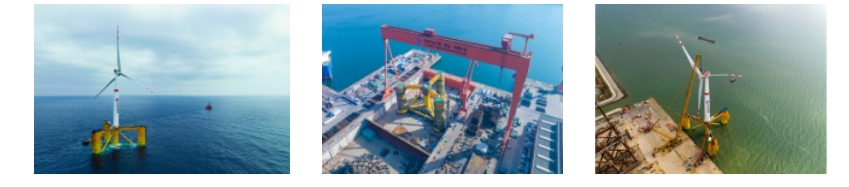
Project: CNOOC GUANLAN
Time of completion:June 2023
Project introduction: As China’s first deep-sea floating wind power turbine platform, Guanlan has a capacity of 7.25 MW, an overall height of more than 200m and a total draft weight of 11,000 tons, with the water depth of 120m. The annual power generation of the wind turbine can reach 22 million kilowatt hours. Through the dynamic submarine cable, it can save nearly 10 million cubic meters of natural gas and reduce carbon dioxide emissions by 22,000 tons per year.
Project highlights: Guanlan is China’s first floating wind power turbine platform with a working sea area of more than 100km from the coastline and a water depth of more than 100m. It is also the world’s first semi-submersible deep-sea wind power turbine platform that supplies power to offshore oil and gas fields and has the worst marine environment, which poses a huge challenge to the platform design. Through technological innovations such as optimizing the platform scale and adding efficient damping structures, the platform capable of resisting the maximum 17-level super typhoon. The tilt angle is only about 10 degrees in extreme environment, and it can ensure the safety of the wind turbine at a wind speed of 84 m/s.
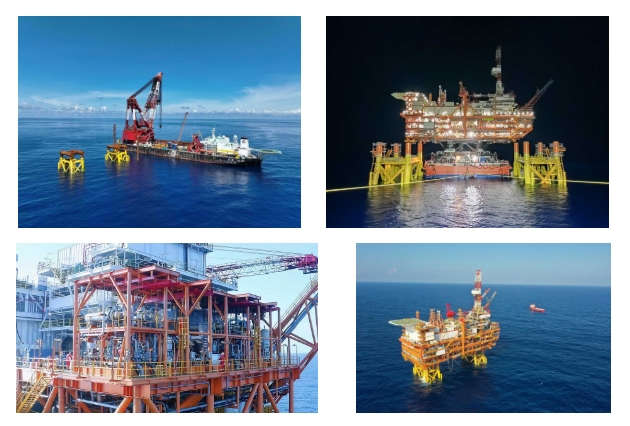
Project: Enping 15-1 Oilfield Group Regional Development Project (CCUS)
Time of completion: November 2023
Project introduction: The Enping 15-1 Oilfield Group joint development project has built four new platforms EP15-1CEP, EP20-4DPP, EP10-2WHPA, EP20-5WHPA, four new double-layer subsea pipelines with a total length of 100km, 57km new submarine/umbilical cables. It is also the first offshore carbon dioxide capture and storage project in China.
Project highlights: COOEC realized the offshore demonstration application of CCUS, and completed the Enping 15-1 carbon dioxide storage project, which was successfully put into operation in 2023. With the first offshore carbon dioxide storage demonstration project in China, the carbon dioxide associated with the oil field can be captured and treated and then injected back into the seabed in a certain burial depth for permanent storage, achieving zero carbon dioxide emissions.
The main innovation points of carbon dioxide re-injection technology are as follows: The process design technology, integrated design technology, integrated construction technology and debugging technology of supercritical CO2 booster re-injection system are developed for the first time.
The annual storage reaches 300,000 tons, equivalent to nearly 14 million trees planted every year, filling the gap in China’s marine carbon dioxide storage technology.